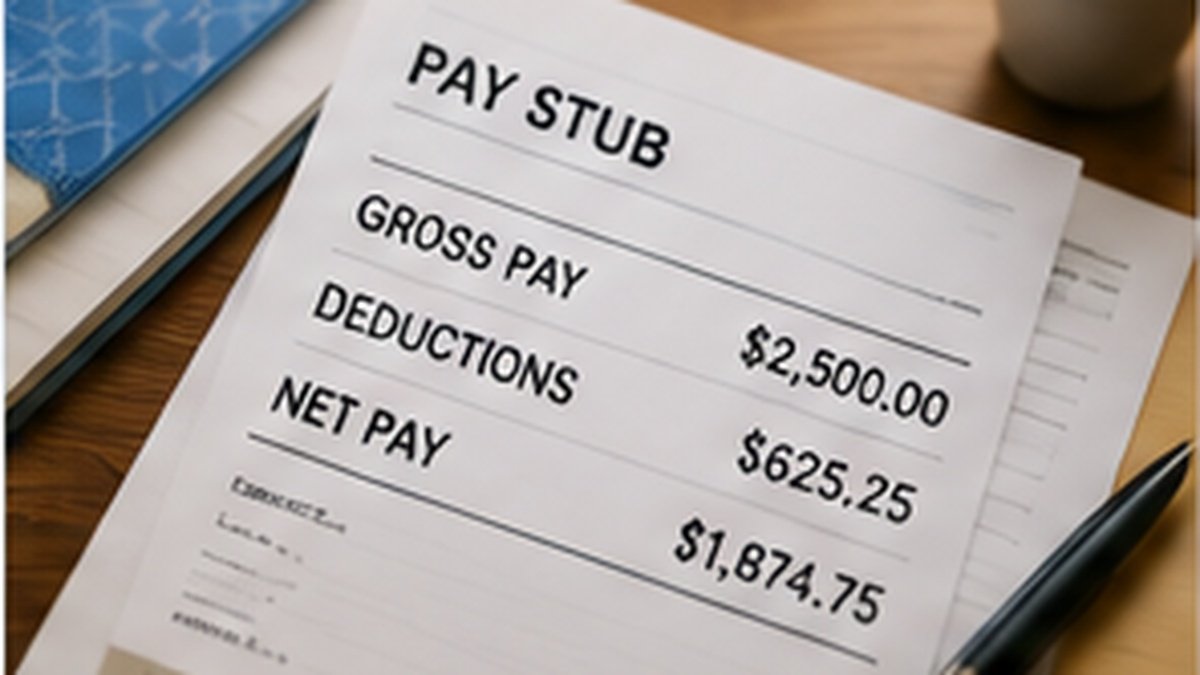
Gross pay is what you earn before deductions. Net pay is what reaches your bank account after payroll deductions and other authorized amounts are taken off. The distinction matters whenever you compare job offers, read a pay stub or build a monthly budget.
In Canada, the gap is not one fixed percentage. It depends on income, province or territory, pay frequency, tax-credit information, CPP or QPP, EI, taxable benefits and workplace deductions.
Gross pay vs. net pay at a glance
| Term | What it means | Best used for |
|---|---|---|
| Gross pay | Earnings before deductions | Comparing compensation and checking hours or salary |
| Taxable income | Income used in the tax calculation after applicable adjustments | Tax reporting and planning |
| Net pay | Amount left after payroll deductions | Cash-flow and household budgeting |
How gross pay is calculated
Hourly employees
Gross pay = hourly rate × paid hours. If someone earns $28 per hour and has 75 paid hours in a biweekly period, gross regular pay is $28 × 75 = $2,100. Overtime, premiums, commissions, tips processed through payroll, bonuses and taxable benefits may change the total.
Salaried employees
A simple regular-pay estimate divides annual salary by the number of pay periods. For a $72,000 salary:
- Biweekly: $72,000 ÷ 26 = about $2,769.23 gross per pay.
- Semi-monthly: $72,000 ÷ 24 = $3,000 gross per pay.
- Monthly: $72,000 ÷ 12 = $6,000 gross per pay.
Actual payroll may treat partial periods, bonuses and benefits differently. See the biweekly versus semi-monthly guide for timing differences.
What commonly reduces gross pay
Income tax
Employers generally withhold federal and provincial or territorial income tax based on payroll rules and the information on your tax forms. Withholding is a prepayment toward the annual tax calculation; it is not necessarily your final tax bill or refund.
CPP or QPP contributions
Most eligible workers contribute to the Canada Pension Plan, while Quebec workers generally contribute to the Quebec Pension Plan. Annual rates, exemptions and maximums can change, so use the Canada Revenue Agency’s current payroll information rather than a fixed percentage copied from an old article.
Employment Insurance
Eligible employment generally has EI premiums withheld; Quebec also has province-specific arrangements relevant to payroll. Premium rates and annual maximums can change.
Workplace and voluntary deductions
Pension contributions, union dues, group insurance, health spending, retirement-plan contributions, charitable giving, parking or other authorized deductions may appear on the pay stub. Some reduce taxable income and some do not. Ask payroll when the treatment is unclear.
Worked paycheque example
This example explains the arithmetic only. The deductions are illustrative, not current tax rates or a payroll estimate.
| Item | Illustrative amount |
|---|---|
| Gross pay | $2,100 |
| Income tax withheld | −$310 |
| CPP/QPP contribution | −$105 |
| EI premium | −$35 |
| Workplace benefits | −$70 |
| Net pay | $1,580 |
$2,100 − $310 − $105 − $35 − $70 = $1,580 net pay.
Do not use those sample deductions to predict your cheque. Use the CRA’s Payroll Deductions Online Calculator or your employer’s payroll estimate with current inputs.
Why two people with the same salary can have different net pay
- They live in different provinces or territories.
- Their tax-credit forms contain different information.
- One participates in a pension or benefits plan.
- They have different bonuses, commissions or taxable benefits.
- One has reached an annual CPP/QPP or EI maximum later in the year.
- Their pay frequencies or period-specific hours differ.
Gross income versus take-home pay when budgeting
Use net pay for rent, groceries, debt payments and savings because that is the cash available. If income varies, calculate a conservative baseline from several ordinary pay periods and keep bonuses or overtime separate until received.
Convert pay frequency correctly. Biweekly workers usually receive 26 pays per year, while semi-monthly workers receive 24. Multiplying every biweekly cheque by two understates annual pay and can make two three-paycheque months seem like dependable monthly income.
How to check a Canadian pay stub
- Confirm the pay period and payment date.
- Check hours, rate, salary portion, overtime and other earnings.
- Review taxable benefits and reimbursements separately.
- Compare statutory and workplace deductions with previous periods.
- Check year-to-date totals.
- Ask payroll promptly about missing hours or an unfamiliar deduction.
Frequently asked questions
Is net pay the same as after-tax income?
People often use the phrases interchangeably, but net pay may also reflect pension, insurance, union or other deductions beyond income tax.
Why did my net pay change when my gross pay did not?
A benefit deduction, tax-form change, annual maximum, retroactive adjustment or payroll correction may have changed. Compare the two pay stubs line by line and ask payroll if needed.
Are bonuses taxed at a permanently higher rate?
Withholding on a bonus may look high because payroll applies prescribed methods, but final annual tax depends on total taxable income and applicable credits and deductions.
Should I use gross or net pay for rent affordability?
Some housing benchmarks and applications use gross income. For your personal cash-flow test, net pay is more useful because it shows what is available after payroll deductions.
Official sources
- Financial Consumer Agency of Canada: Starting your first job
- Canada Revenue Agency: Calculate payroll deductions and contributions
- CRA Payroll Deductions Online Calculator
General information only. It is not individualized tax, payroll, legal or financial advice.
This information is general and may change. Check the linked official source for rules that apply to your situation.